Epilepsy is disease of the brain characterised by the tendency to have recurrent seizures. It is the fourth most common brain disorder after migraine, stroke, and Alzheimer’s Disease. Although epilepsy can be diagnosed at any age, it is more likely to be diagnosed in childhood or senior years, and many people have their first seizure(s) during childhood or adolescence.
Epilepsy is more than having seizures. It can affect people in many ways, especially when seizure freedom cannot be obtained. Although unpredictable seizures define epilepsy, the cognitive and emotional difficulties encountered by people with epilepsy may have an even greater impact on everyday function than the seizures themselves.[i] For instance, people with epilepsy are more at risk of developing anxiety or depression, experience changes in mood and behaviour, or have difficulties with learning and memory and other psychosocial consequences (bullying, stigma). Many of these consequences can significantly affect quality of life. [ii]
These effects can be amplified for people with poorly controlled seizures.
While two out of three people with epilepsy become seizure free with medication, this means one in three continue to have seizures despite taking medication.
How will epilepsy affect my child?
For parents of children with epilepsy, it is natural to be concerned about how it may affect your child. There is no straight forward answer to this because epilepsy is a complex disorder and symptoms are different for each person. The ripple effects will also differ, and it may or may not affect aspects of a child’s development and functioning. Circumstances that influence how it affects a child include: the cause of the epilepsy; the type of epilepsy and seizures; when the seizures occur and how often they occur; the medication the child is taking; and the child’s individual circumstances.
NOTE: The issues discussed in this article may not necessarily be relevant to your child – the effects of epilepsy can differ greatly.
Some of the ways epilepsy can affect child development include:
Cognitive and learning difficulties.
Cognitive = relating to, being, or involving conscious intellectual activity (such as thinking, reasoning, or remembering)
Up to half of children with epilepsy have some form of learning difficulty. The types of learning problems associated with epilepsy vary greatly and can range from very subtle, but still impacting performance, to severe, affecting several areas of brain function and overall aptitude.[iii] The functions most often affected by epilepsy are attention, memory, executive functioning, speech, and language.
Poor executive functioning can have a major impact on learning and behaviour. In practical terms, executive skills help people to: [iv]
- Plan and organise their approach to various tasks and activities.
- Develop strategies and change them according to the situation or task.
- Evaluate information to make decisions, adapt to new situations.
- Use feedback to modify their behaviour.
Problems in any number of executive skills can lead to significant learning and behavioural difficulties.
Antiseizure medications can sometimes affect cognitive function but are generally very well tolerated.
Learning difficulties don’t necessarily mean the child is not smart or capable, but they may require additional support to learn.
Behavioural concerns
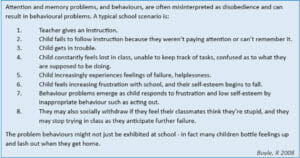
As mentioned above, cognitive difficulties can also lead to behaviours. Research has shown that there is increased frequency of behaviour problems in children with epilepsy. [v]
Seizure activity and the medications used to treat epilepsy can affect behaviour and mood, so children with epilepsy may experience mood and behavioural changes, particularly if they are taking multiple medications or if their seizures are poorly controlled.
Children with epilepsy may be at increased risk for developing attention-deficit/hyperactivity disorder (ADHD), anxiety, and depression.[vi] These conditions can also impact their ability to learn, socialise, and function in daily life.
ADHD is more common in children with epilepsy compared to peers. Some aspects of the epilepsy and its treatment could contribute to ADHD symptoms, for example, children with complicated epilepsy may be at greater risk for ADHD, and some antiseizure medications can contribute to ADHD symptoms. However, the seizure disorder and its treatment are not likely the sole cause of increased occurrence of ADHD in these children, as shown by the increased presence of ADHD symptoms even before diagnosis of a seizure disorder. vi
Social and Emotional Issues
Some children with epilepsy may struggle with social and emotional issues, more so than their peers. This includes anxiety, depression, low self-esteem, and social isolation. These issues may be related to a combination of matters including the stigma surrounding epilepsy, the fear of having seizures, difficulties at school, as well as the effects of seizures and antiseizure medication. This can have an impact on the child’s overall well-being and quality of life. i
Depression and/or anxiety are seen in about 1 in 4 children with epilepsy.
Depression and anxiety can impact learning, and your child may have trouble concentrating, thinking clearly, or making decisions. They can also affect memory and can even cause confusion, or the child becoming overwhelmed or becoming frustrated easily. Even everyday tasks can be difficult for someone with depression and anxiety.
Knowing the signs can help detect it earlier and seek treatment.
Medication side effects
The first line of treatment for epilepsy is usually antiseizure medications (ASMs), which are designed to prevent seizures by altering the abnormal electrical activity in the brain. While ASMs can be effective in reducing seizures, like all medications, they can also have side effects, which can include mood changes, behavioural problems, drowsiness, and sleep disturbances.
There are three main types of ASM side effects.[vii]
Mild side effects are common when starting the medications, particularly if the dose is increased quickly. These include nausea, abdominal pain, dizziness, sleepiness, irritability, anxiety or mood changes. These are usually not serious but may worry some people and should be discussed with your doctor or pharmacist.
Dose related side effects are common to ASMs when prescribed at too high a dose and can cause unsteadiness, poor concentration, sleepiness, double vision, vomiting, tremor. It is important to report these side effects to your doctor immediately if they occur.
Serious but uncommon side effects are specific to individual medications and only occur in some people, for instance a rash, blood problems, liver problems, severe behaviour disturbance, worsening of seizures.
You will need to refer to the specific drug information provided with your medication for a more detailed list of side effects. As numerous side effects are listed against all medications, your doctor should help you understand which the more common or potentially serious side effects are to look out for. It is important to contact your doctor if you are worried about these or other side effects.
Moving forward
Different children will have very different experiences of how epilepsy affects them, and the impact it has on their learning and development. Some children have no major issues whilst other children are more affected by their condition, and may have significant struggles.
Keep a record
It’s a good idea to keep a diary so you can trace details back and look at when things (such as more seizures, medication changes) happened that might affect learning, concentration, moods, and behaviour. This can help identify patterns or reasons for specific problems or events. It can also be helpful for your child’s paediatrician or neurologist to see diarised events as well.
Get a baseline assessment
If you have concerns about your child’s learning development, it may be a good idea to arrange an neuropsychological assessment with a clinical neuropsychologist. A neuropsychologist is a psychologist who specialises in understanding the relationship between the physical brain and behaviour. Clinical neuropsychologists assess and treat people with brain conditions that affect memory, learning, attention, language, reading, problem-solving and decision-making. They can determine your child’s strengths and weaknesses, and exactly what areas your child will have difficulties with. They also recommend appropriate treatment or can develop a plan and strategies to help.
Managing seizures
Good seizure control can often help with reducing the impact of seizures on other aspects of health and wellbeing, and quality of life. In addition to taking medication as prescribed, it is also important to:
Identify seizure triggers. Certain factors, such as stress, lack of sleep, and flashing lights, can trigger seizures in some children with epilepsy. It can be helpful to identify and avoid these triggers when possible.
Learn about your child’s type of epilepsy. Educating yourself can help with understanding.
Check with your child’s doctor before taking other medicines or supplements. It is important to do this, so they don’t have any unexpected seizures or unwanted side effects.
Ensure your child:
- Gets an appropriate amount of sleep each night
- Has daily exercise and a well-balanced diet
- Has some techniques they can practice to lower stress.
Speak to your child’s doctor about any concerns and seek a second opinion if you wish.
Seek help for behavioural or mental health issues. Managing mental health can also improve seizure control.
Know seizure first aid: It is important to teach your child, their teachers, and other caregivers how to respond in the event of a seizure.
Get a review
If you find that the antiseizure medication is not giving your child the best seizure control they can have, then it is worth seeking an epilepsy specialist for a review or second opinion. You have the right to ask for a second opinion if you are unsure about your current doctor’s suggested medical treatment or diagnosis.
An epilepsy specialist has more extensive epilepsy knowledge and there are other treatment options that may be suitable for your child, such as epilepsy surgery, dietary therapies and vagus nerve stimulation.
Explain to your doctor or specialist that you need to consider your options and would like advice from another doctor. See our factsheet You and Your Doctor
Summary
When your child is diagnosed with epilepsy, it can be a shock and you may experience a range of emotions. Epilepsy is not a condition to be feared. It is important to have a good general understanding of epilepsy because it often extends beyond seizures. It is easy to see the physical effects of epilepsy if someone has a seizure but the effects on other aspects of functioning – such as cognition, learning, moods and behaviour – are often less obvious and can be missed or overlooked.
Be sure to discuss with your child’s doctor about their epilepsy type so you can start the learning about it and the process about how to help your child.
We have two free online courses for school aged children:
And an online tool for parents:
- Strong Foundations – designed to help parents with a child attending mainstream school identify any epilepsy-related learning challenges. It aims to give parents ideas about how to support their child to achieve their potential.
Read about Medical Management and Self-Management for epilepsy.
Join the Source Kids Community for parents, carers and professionals of children with special needs.
Raising Children has some useful resources and advice.
If you wish to speak to an Epilepsy Nurse, call our National Epilepsy Line 1300 37 45 37 or email [email protected]
[i] Hixson JD, Kirsch HE. The effects of epilepsy and its treatments on affect and emotion. Neurocase. 2009 Jun;15(3):206-16. doi: 10.1080/13554790802632876. PMID: 19204849.
[ii] Michaelis, R., Tang, V., Goldstein, L. H., Reuber, M., LaFrance Jr, W. C., Lundgren, T., … & Wagner, J. L. (2018). Psychological treatments for adults and children with epilepsy: Evidence‐based recommendations by the International League Against Epilepsy Psychology Task Force. Epilepsia, 59(7), 1282-1302.
[iii] Massachusetts General Hospital. Childhood Epilepsy: Learning https://www.massgeneral.org/children/epilepsy/education/learning Accessed 29 May 2023
[iv] Boyle, R. Neuropsychologist. (2008) The school years and beyond. Epilepsy 360 article, Epilepsy Action Australia.
[v] Keene, D. L., Manion, I., Whiting, S., Belanger, E., Brennan, R., Jacob, P., & Humphreys, P. (2005). A survey of behavior problems in children with epilepsy. Epilepsy & Behavior, 6(4), 581-586.
[vi] Williams, A. E., Giust, J. M., Kronenberger, W. G., & Dunn, D. W. (2016). Epilepsy and attention-deficit hyperactivity disorder: links, risks, and challenges. Neuropsychiatric disease and treatment, 12, 287–296.
[vii] Royal Childrens Hospital Melbourne https://www.rch.org.au/Antiepileptic_medications.aspx Accessed 29 May 2023