I can never really accurately recall the day I realised I was having seizures. I know that it was somewhere in my early teens, about 13 or 14 that I started having “smells” and unusual sensations. I know that over some 30 or so years I’d experience the highs and lows of a life journey as an epileptic. The fear of the outcomes, the worry of the brain damage being caused by every seizure- would I lose my memory, get dementia early, etc, the highs and lows of new medications that had initial success before turning into unsuccessful failures.
The search for relief from epileptic seizures can sometimes be a long and frustrating one. The list of medications is lengthy and I’m sure that during my 35 years suffering complex partial seizures (now called focal seizures) I’ve been on most of them at some point. Unfortunately for me, most of the meds had a “honeymoon period” before their impact diminished. So too, undergoing EEGs, MRIs and other forms of testing can be quite time consuming and sometimes unsuccessful. However, medical science is well advanced, and I was fortunate enough to find an answer to my predicament through surgery.
It’s certainly not the most pleasant of ideas having a surgeon remove some of your brain and there are obviously a number of concerns that go with surgery, most of them with a small percentage risk. There are also obviously no guarantees, however, the surgery has an 80% success rate in most circumstances and that is a positive well worth considering. It is important to note here that not all patients are viable for surgery and some forms of epilepsy may simply be inoperable.
I know I delayed it for a lot longer than I probably should have done.
I can’t recall how long I was considered eligible for surgery, but I know I delayed it for a lot longer than I probably should have done. The decision to have surgery is not an easy one. If your Neurology team says that surgery is a viable option, my advice would be to become educated not only on the procedure itself, but also on the benefits of such surgery. I watched hours of YouTube and other clips of the surgery – which may not be for the fainthearted, read widely including medical journals like the Lancet and generally became somewhat over educated about the operation. I went into the surgery with a good understanding of what was to happen. I was probably a little over educated on it.
Obviously, my surgery involved not only opening the skull, but also removing significant brain tissue. So, read through the list of possible risks, and I think the ones that concerned me the most were more so related to seizures themselves. In particular, some of the risks included increased number of seizures, increased severity of seizures (worse type) and even no change at all. Whilst I’m probably not selling the positives of the surgery well, those were the realities. In the end, the benefits for me far outweighed the small risks.
So too, ask plenty of questions – not just of your Neurology team, but also of those who have had or are contemplating the surgery. Confront your fears about the surgery with those who have experienced the procedure. I know that the one thing I didn’t initially get enough of was dialogue with patients – people who had actually gone through the surgery. Their reassurance was what I probably needed the most.
Knowledge from a patient who already had the surgery was the final nudge I needed
There were so many questions I needed answered that could only come from a patient. What was the pain like afterwards? Did you have scars? Did you have any more seizures? How long did it take to recover? The list of questions was pretty extensive and whilst my Neurology team was awesome, unless they had been a patient, they could only answer these on a second-hand basis. Of all the material I found, having this knowledge from a patient probably was the final nudge I needed.
So, after letting my consultant know I intended to go forward, I underwent quite a bit of pre-operation testing as part of the preparation. Spending a number of hours under an MRI machine for functional testing to ensure my brain was well mapped was the first step. Obviously, this is quite critical to ensure that surgeons are aware of the active areas of your brain. So too, a series of psychological tests were done pre and post-surgery to be able to identify any anomalies.
After surgery
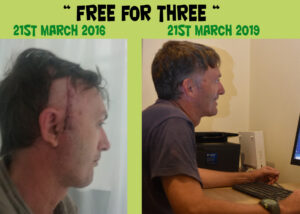
I recall waking up later in the evening. My expectations for my regaining consciousness was to discover I had tubes everywhere, connected to monitors, etc. The reality was that there were very few tubes in me aside from a drip canular and a catheter. I could feel the staples down the side of my face where my skin had been stuck back together. Obviously there was pain, but the medication that I was on pretty much nullified that issue.
In the end it comes down to deciding upon how badly you want to be rid of epilepsy. There are no guarantees and I’m not qualified to provide any medical advice – that’s best sought from your Neurology team. However, I encourage you to at least investigate the operation thoroughly before making a final decision. Don’t cheat yourself out of the potential to be free of seizures.
Whilst I have no medical qualifications, I do write from the point of view of someone who has a wealth of experience as epileptic for 35 years and is now the survivor of successful surgery to free me from the grips of epilepsy.
NOTE: Dominic is happy to communicate with people contemplating epilepsy surgery and discuss his experience. Please contact us on 1300 37 45 37 or email [email protected] to connect.